Our History
1965
During the Second Vatican Council in 1965, the Council Fathers decided that “all preaching in the Church, as well as all Christian life, should be nourished and governed by Holy Scripture”. Dei Verbum : this is the Dogmatic Constitution on Divine Revelation (no.21).
1969
In response to this conciliar document, the World Catholic Federation for the Biblical Apostolate was founded on April 16, 1969. Since 1990 it has been known as the Catholic Biblical Federation.
1974
The Biblical Apostolate began in Africa in English-speaking countries in July 1974 with the initiative of Fr. Adrian SMITH in Lusaka, Zambia, under the supervision of the Catholic Biblical Federation, the Biblical Apostolate in Stuttgart (Germany).
1975
In 1975, the Symposium of Episcopal Conferences of Africa and Madagascar (SECAM) mandated (Ref. N°. WCFBA 75/86), the Catholic Biblical Federation for the Biblical Apostolate, today called the Catholic Biblical Federation, to study the possibility of establishing a permanent center of the Biblical Apostolate in Africa and the surrounding Islands.
The office of FBCAB (for Africa) was first established in Lusaka, Zambia, before being transferred to Lomé, Togo in 1978. In January 1978, the Secretary General of FBCAB wrote to the Fr. Wynnand AMEWOWO (from Diocese of Ho in Ghana) to replace Fr. Adrian SMITH, because SECAM wanted that the work continues, if possible, with an African priest at the head of the office (Ref. N°. 100,000 of January 16, 1978). Fr. Wynnand Amewowo worked in the Biblical Apostolate from October 1978 to October 1981.
1978
The French-speaking section of the Biblical Apostolate in Africa began in January 1978 under the direction of Fr. Edward Skeveres, SVD, who was at the same time Diocesan Director of the Biblical Center of Lomé, until December 1979.
In December 1978, the Secretariat of the FBCAB transferred Fr. Amewowo and the English-speaking African office to Lomé so that the two French-speaking and English-speaking services of the Biblical Apostolate collaborate and work out from Lomé (Togo)
1980
The Executive Committee of the Catholic Biblical Federation decided in Mexico-City to make autonomous the regional services in Africa, Latin America and Asia, from May 1980,.
1981
The sixth Plenary Assembly of SECAM in Yaoundé/Cameroon decided to create BICAM. On July 5, 1981, BICAM was formally established for the promotion, coordination and organization of the biblical apostolate in Africa and Madagascar. The creation of BICAM put an end to the African office of the Catholic Biblical Federation for the Biblical Apostolate. BICAM is the official organ of SECAM for the biblical apostolate in Africa and Madagascar (see the document of SECAM establishing the Biblical Center for Africa and Madagascar 2.3.i and ii.)
1982
In 1982, BCAM steering committee was transferred from Lomé/Togo to Nairobi in Kenya. The office was set up briefly at AMECEA heartquaters and later at its own property in Karen/Nairobi under the direction of Fr. W. Amewowo (1981-1991).
1991-2005
In 1991, Fr. Laurent NARE (from the Archdiocese of Koupéla/Burkina Faso) became Director of BICAM (1991-1997). Fr. Peter NJOROGE of the Diocese of Eldoret/Kenya was the head of BICAM from 1997 to 1998. After him, Fr. Peter LWAMINDA from the Archdiocese of Kasana in Zambia from 1998 to 2002; Fr. Henry Terwase AKAABIAM of the Diocese of Markudi (Nigeria) (2002-2005) with Fr. Moïse Adeniran Adekambi of the Diocese of Porto-Novo in Benin as Deputy Director.
Pope John Paul II, in his post-synodal apostolic Exhortation Ecclesia in Africa, recognized and confirmed the mission of BICAM. He said :
“ The Word that comes from the mouth of God is living and active, and never returns to him in vain (cf. Is 55:11; Heb 4:12-13). We must therefore proclaim that Word tirelessly, exhorting “in season and out of season … unfailing in patience and in teaching” (2 Tim 4:2). Entrusted first of all to the Church, the written Word of God is not “a matter of one’s own interpretation” (2 Pet 1:20), but is to be authentically interpreted by the Church.
In order that the Word of God may be known, loved, pondered and preserved in the hearts of the faithful (cf. Lk 2:19,51), greater efforts must be made to provide access to the Sacred Scriptures, especially through full or partial translations of the Bible, prepared as far as possible in cooperation with other Churches and Ecclesial Communities and accompanied by studyguides for use in prayer and for study in the family and community. Also to be encouraged is the scriptural formation of clergy, religious, catechists and the laity in general; careful preparation of celebrations of the Word; promotion of the biblical apostolate with the help of the Biblical Centre for Africa and Madagascar and the encouragement of other similar structures at all levels. In brief, efforts must be made to try to put the Sacred Scriptures into the hands of all the faithful right from their earliest years.(EIA, No. 58)
2003-2004
During the 13th Plenary Assembly of SECAM in Dakar (Senegal) in October 2003, the Bishops of SECAM decided to transfer BICAM office from Nairobi to the SECAM Secretariat at Senchi Street 4, Accra, Ghana. The decision was made on June 30, 2004.
2005-2017
BICAM headquarters remained in Accra from 2005 to 2017, under the direction of Fr. Henry terwase Akaabiam, of the Diocese of Markudi in Nigeria (2002-2005); Fr. Moïse Adeniran Adekambi, from the Diocese of Porto-Novo in Benin (2005-2011); Fr. Julien Ivaga Ndjana, of the Archdiocese of Yaoundé/Cameroon (2011-2016).
2017 up to date
In 2017, CEBAM headquarters moved again from Accra to Nairobi/Kenya with Rev. Prof Albert Ngengi Mundele as Director in Karen/Nairobi. He received the mission to build a center for biblical formation and animation. He works hard to find funds.
Who Are We?
The Catholic Biblical Centre for Africa and Madagascar (BICAM) is the official organ of SECAM for the promotion, coordination and organization of the Biblical Apostolate and Bible Translations in African languages. It reports to the SECAM Commission of Evangelization which is headed by the SECAM First Vice President. The day-to-day administration of the office is carried out by the First Deputy Secretary General of SECAM.
BICAM is therefore composed of:
1) Structures of Biblical Apostolate and institutions of the Regional and National Episcopal Conferences of SECAM;
2) Structures of Diocesan Biblical Apostolate
3) Any type of organization working in the Biblical Apostolate on the mainland and the islands of Africa.
In 2019
– His Exc. Mgr. Lucio Andrice MUANDULA, Bishop of Xai-Xai / Mozambique, 2nd Vice-president of SECAM, in charge of the Commission of Evangelization of SECAM.
– Rev. Dr. Rafaël SIMBINE, 1st Deputy Secretary General of SECAM.
Since 2017:
The current Director of BICAM is Fr. Anselm Kamuyu of the Archdiocese of Nairobi Kenya.
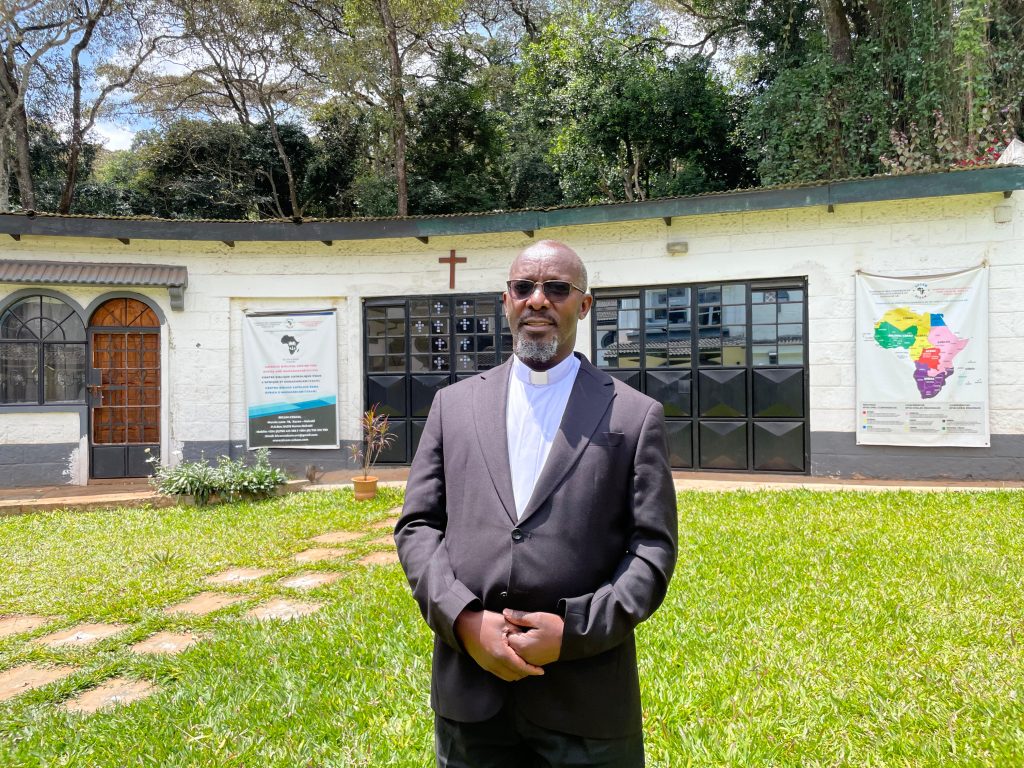
The Former Directors of CEBAM:
1) Msgr. Wynnand AMEWOWO, from HO Diocese / Ghana (1978-1981; 1981-1991)
2) Fr. Laurent NARE, from the Archdiocese of Koupéla / Burkina Faso (1991 – 1997)
3) Fr. Peter NJOROGE, from the Diocese of Eldoret / Kenya (1997-1998)
4) Fr. Peter LWAMINDA, from the Archdiocese of Kasama / Zambia (1998-2002)
5) Fr. Henry Terwase AKAABIAM, from the Diocese of Markudi / Nigeria (2002-2005)
(With his deputy, Fr. Moise Adenira Adekambi, from the Diocese of Porto-Novo / Benin)
6) Fr. Moise Adenira ADEKAMBI, from the Diocese of Porto-Novo / Benin (2005-2011)
7) Fr. Julien IVAGA NDJANA, from the Archdiocese of Yaoundé / Cameroon (2011-2016)
8) Rev. Prof Albert Ngengi Mundele of Diocese of Kenge/ Congo (2017 – 2025)
Establishment Document
https://bicamcebam.org/wp-content/uploads/2024/02/BICAM-ESTABLISMENT-DOCUMENT-2.pdf
The Implications of BICAM-CEBAM :
1. To make the Bible accessible to the people of Africa, in the languages that the people understand.
2. Promoting Bible-rooted spirituality at all levels;
3. To promote research from the African perspective, embody the word of God in the lives and cultures of the people;
4. To promote and coordinate the Biblical Apostolate at all levels in Africa and Islands
5. To train Biblical Apostolate animators at regional and national levels;
6. To strengthen collaboration with Bible Societies at continental, regional or national levels.